Quantum key distribution transmits key material on single photons. Its security follows from measurement physics: an eavesdropper cannot observe the channel without introducing detectable error. No software offers an equivalent guarantee, since every classical scheme depends on some piece of mathematics staying hard.
The engineering difficulty is dynamic range. A classical data channel runs many orders of magnitude brighter than a single-photon channel (a floodlight and a candle sharing the same lens), and scattered light from the data beam swamps the quantum detectors.
The conventional fix is brute separation: a dedicated fiber or a second telescope for the quantum channel. On an aircraft or a small terminal that doubles the optical assemblies and the mass budget, which is why the platforms that most need un-interceptable links have gone without them.
The approach we use was initially developed by NASA's Glenn Research Center and is protected under US 11,588,628 (A. Wroblewski, 2023). Space-and-wave (SAW) division works at the receiver: both channels arrive through the same telescope and are focused into a commercially available double-clad optical fiber. Think of a straw running down the center of a pipe. The lens's diffraction pattern, with the two wavelengths chosen accordingly, drops the quantum photons into the fiber's 9 µm core (the straw) and the high-power data signal into the 105 µm cladding around it (the pipe). The candle and the floodlight share one lens, and geometry does the sorting without duplicated optics or exotic components.
Two design choices distinguish the suite from most QKD systems. First, keys are transmitted as weak coherent pulses rather than entangled photon pairs, which keeps the source hardware practical and makes the method applicable to any free-space optical link. Second, the suite addresses the unglamorous integration problems that usually stall QKD deployments: generating random measurement bases on demand, and converting the variable-length keys QKD naturally produces into the fixed-length keys that mainstream symmetric encryption (e.g., AES-256) requires.
The consequence is architectural. A single aperture and fiber plant carry a continuously refreshed, physics-protected key channel alongside gigabit-class traffic, with room left over for timing and synchronization channels.
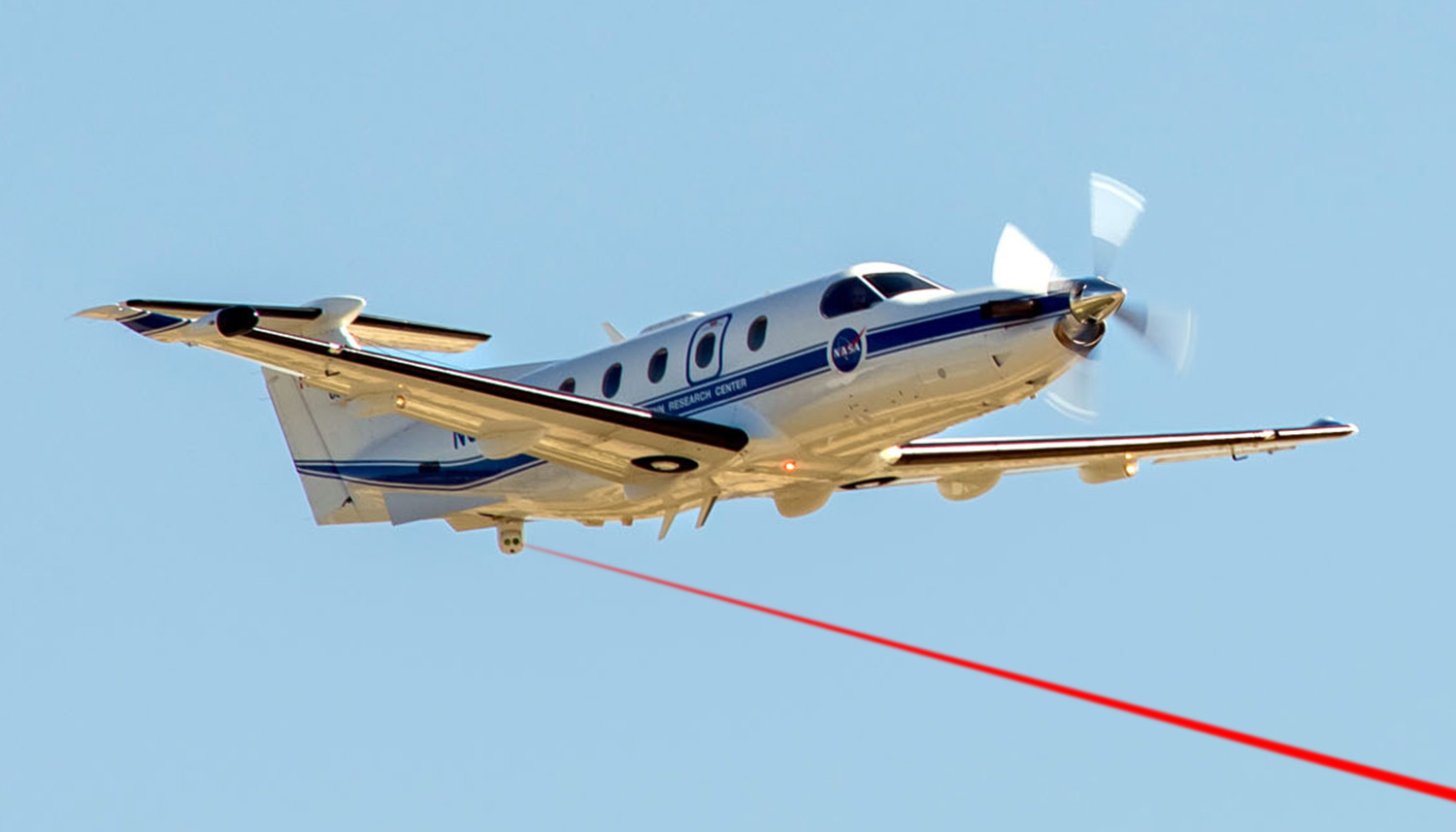
The transceiver work sits on NASA Glenn's Airborne Laser Communication Testbed (ALCT). Per NASA's published program summary, the testbed accumulated more than 50 hours of operational link time across three flight campaigns between 2019 and early 2025, flown on DHC-6 Twin Otter and Pilatus PC-12 aircraft against a ground station at Glenn's hangar facility. NASA reports sustained gigabit-class data rates at slant paths up to 60 km, with air-to-air tracking validated through retroreflector testing.
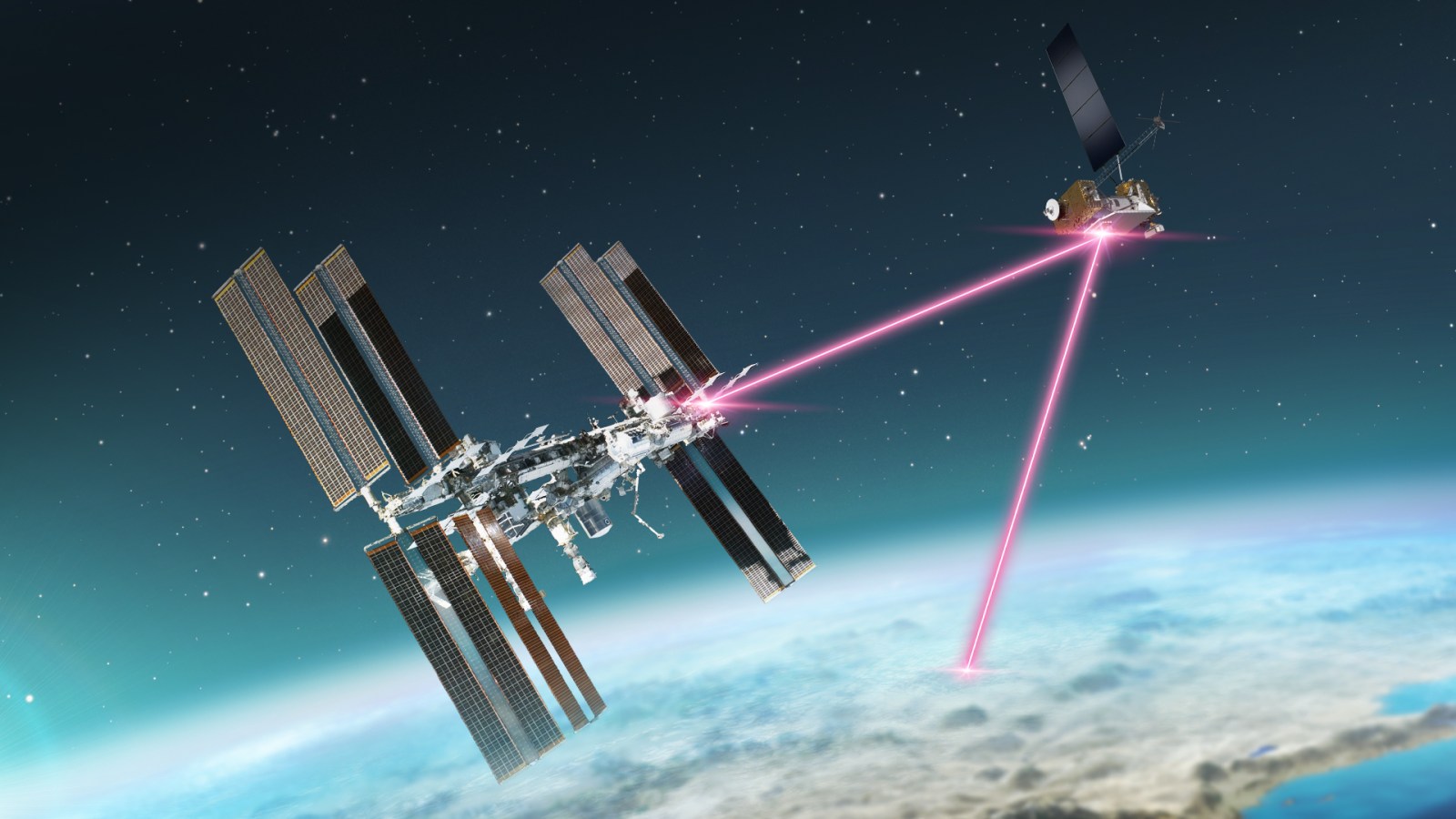
In July 2024, Glenn used the same PC-12 terminal lineage to stream the first 4K video from an aircraft to the International Space Station and back, at rates exceeding 900 Mbps: aircraft to Cleveland optical ground station, terrestrial network to White Sands, then optical relay through LCRD to the ILLUMA-T terminal on station (NASA, July 24, 2024).
NASA's stated advantages for the modality are the ones that matter operationally: high throughput relative to RF, low probability of interception and detection, immunity to RF jamming, and operation outside RF spectrum allocation. The stated constraint is equally plain: the link requires clear line of sight.
Narrow optical beams are difficult to intercept or even detect off-axis (NASA ALCT summary).
Unaffected by RF interference; contested-spectrum environments do not degrade the link.
Operates outside RF spectrum allocation and its licensing constraints.
The honest constraint: optical links require clear line of sight within operational range.
We hold an executed NASA research license to the LEW-TOPS-163 technology suite, which NASA rates at TRL 8: system complete and qualified through test and demonstration. HelioLink is the name of the platform we are building on it. A research license grants the right to practice the patented technology for research, development, and evaluation, which is the standard first step in NASA's technology-transfer pathway toward a commercial license. It carries no product endorsement, and we do not sell a finished terminal today.
Our development program addresses the questions a deployable system raises: transceiver packaging and environmental hardening, pointing-acquisition-tracking integration on small platforms, key-management interfaces to existing cryptographic infrastructure, and manufacturability of the optical assemblies. The manufacturability work runs with our research partners at UT Austin's Nanoscale Design and Manufacturing Laboratory and within the AIM Photonics ecosystem.
We publish what we can substantiate and label the rest as open work. Organizations evaluating the technology for specific missions can request our current development status under NDA.
We can walk your technical staff through the architecture, the NASA source material, and our development roadmap.